
PEX-AL-PEX vs. PEX vs. PPR. How to Choose the Right Pipe for Your Plumbing Project?
Selecting the right piping material is crucial for the longevity, efficiency, and cost-effectiveness of your plumbing or heating system. Three popular contenders are PEX, PEX-AL-PEX, and PPR. Each has distinct strengths and weaknesses. Let’s break them down to help you decide which is best for your project.
PEX (Cross-linked Polyethylene)
PEX (Cross-linked Polyethylene)
What it is: Flexible plastic tubing made by cross-linking polyethylene molecules, significantly enhancing its temperature and chemical resistance compared to standard polyethylene. Common types are PEX-A, PEX-B, and PEX-C (differing mainly in manufacturing method).
Key Advantages:
Excellent Flexibility: Easy to snake through walls and around obstacles, minimizing fittings and reducing installation time and potential leak points.
Freeze Resistance: Can expand and contract without bursting if water freezes inside (though not immune to damage under extreme conditions).
Corrosion & Scale Resistant: Immune to corrosion from water or soil and resists scale buildup.
Cost-Effective: Generally the least expensive option among the three.
Quiet Operation: Dampens water hammer noise.
Wide Availability: Readily available and familiar to most plumbers.
Key Disadvantages:
UV Sensitivity: Degrades with prolonged exposure to sunlight; must be protected during storage and not used for exterior runs.
Oxygen Permeability: Standard PEX allows small amounts of oxygen to diffuse through the pipe wall. This is problematic for closed-loop heating systems (like radiators/underfloor heating) as it promotes corrosion in ferrous components (boilers, pumps, radiators). Requires barrier PEX or specific system designs for heating.
Support Requirements: Needs more frequent hangers/supports due to flexibility.
Potential Rodent Damage: Can be vulnerable to chewing by rodents in some environments.
Best For: Potable water supply lines (hot and cold), radiant floor heating loops (using oxygen-barrier PEX), residential plumbing retrofits, areas prone to freezing.
PEX-AL-PEX (Aluminum Composite Pipe)
PEX-AL-PEX (Aluminum Composite Pipe)
What it is: A composite pipe consisting of three layers: an inner PEX tube, a bonded central aluminum layer, and an outer PEX tube.
Key Advantages:
Oxygen Barrier: The aluminum core completely blocks oxygen diffusion, making it ideal for closed-loop heating systems without risk of system corrosion.
Dimensional Stability: The aluminum layer makes the pipe rigid and highly resistant to expansion/contraction under pressure and temperature changes. Holds its shape well.
Reduced Expansion: Significantly less thermal expansion than pure PEX, minimizing stress on fittings and the need for expansion loops.
High Temperature & Pressure Rating: Excellent tolerance for high temperatures and pressures.
UV Resistance: Outer PEX layer still degrades, but the aluminum provides core protection during storage/handling. Still not for permanent sunlight exposure.
Key Disadvantages:
Less Flexible: Stiffer than pure PEX, making bends slightly harder and requiring specific bending tools to avoid kinking the aluminum layer. More fittings might be needed for complex routes.
Higher Cost: More expensive than standard PEX.
Specialized Tools/Connectors: Requires specific cutters and fittings designed for the composite structure (often compression or press fittings). Not compatible with standard PEX crimp/clamp rings.
Potential Delamination Risk: If damaged or improperly installed, the layers could potentially separate over time (though modern manufacturing is robust).
Best For: Central heating systems (radiators, baseboard heaters), underfloor heating manifolds and distribution lines, high-temperature applications, applications where minimal thermal expansion is critical, situations requiring a superior oxygen barrier.

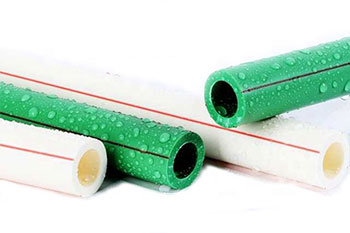
3, PPR (Polypropylene Random Copolymer)
What it is: A rigid thermoplastic pipe made from Type 3 polypropylene random copolymer.
Key Advantages:
Extremely Durable & Long-Lasting: Highly resistant to chemical corrosion, scaling, and abrasion. Very long projected lifespan (50+ years).
High Temperature Resistance: Excellent continuous high-temperature performance (often higher max temp than PEX).
Leak-Proof Joints: Uses heat fusion welding, where pipe and fittings are melted together, creating a monolithic, seamless joint that is as strong as the pipe itself. Virtually eliminates leak points at joints.
Low Thermal Conductivity: Good insulating properties, minimizing heat loss in hot water lines and condensation on cold lines.
Smooth Bore: Maintains excellent flow rates over time.
UV Resistance: Better resistance to UV degradation than PEX, though still not recommended for permanent outdoor exposure.
Key Disadvantages:
Rigid: Cannot bend; requires an elbow fitting for every direction change, increasing fitting count and potential cost/labor.
Specialized Installation: Requires expensive heat fusion welding tools and trained operators. Not a typical DIY material.
Higher Material Cost: Generally more expensive than PEX (though potentially competitive with PEX-AL-PEX).
Slower Installation: Fusion welding takes more time per joint than mechanical PEX connections.
Brittleness at Low Temp: Can become brittle in very cold conditions (though less susceptible to freezing bursts than copper).
Best For: Industrial plumbing, chemical transport, hot water mains, commercial buildings, situations demanding the absolute highest joint integrity and chemical resistance, areas with very hot water.
Comparison Summary Table:PEX-AL-PEX vs. PEX vs. PPR.
| Feature | PEX | PEX-AL-PEX | PPR |
|---|---|---|---|
| Material | Cross-linked Polyethylene | PEX/Aluminum/PEX Composite | Polypropylene Random Copolymer |
| Flexibility | High | Medium (Requires Tools) | Rigid |
| Oxygen Barrier | Poor (Standard) / Good (Barrier Type) | Excellent | Excellent |
| Thermal Expansion | High | Very Low | Medium |
| Temp/Pressure | Good | Very Good | Excellent |
| Joint Method | Crimp/Clamp/Press | Compression/Press | Heat Fusion |
| Joint Integrity | Good (Mechanical) | Good (Mechanical) | Excellent (Monolithic) |
| Freeze Resistance | Excellent | Good | Good (But Brittle Cold) |
| Installation Ease | Easiest (DIY Friendly) | Moderate (Special Tools) | Difficult (Special Tools/Skill) |
| Cost | Lowest | Medium-High | Medium-High |
| UV Resistance | Poor | Poor | Moderate |
| Best Suited For | Potable Water, Retrofit, Radiant (Barrier) | Heating Systems, High Temp, Low Expansion | Hot Water Mains, Industrial, Max Durability |
| Feature | PEX | PEX-AL-PEX | PPR |
4, PEX, PEX-AL-PEX, PPR, Which One is Best for YOUR Project?
Choose Standard PEX (Possibly Barrier PEX): If you need an affordable, flexible, easy-to-install solution for potable water lines (especially retrofits), or radiant floor heating loops (using oxygen-barrier PEX), and freeze resistance is a priority. Best for general residential plumbing and DIYers.
Choose PEX-AL-PEX: If you are installing or repairing a hydronic heating system (radiators, baseboard, underfloor manifolds), need an excellent oxygen barrier, require high temperature/pressure performance with minimal thermal expansion, and can handle the slightly higher cost and specialized tools. Ideal for heating professionals.
Choose PPR: If you prioritize absolute joint integrity and long-term durability above all else, are working with high temperatures or potentially corrosive fluids, are in a commercial/industrial setting, and have access to trained installers with fusion equipment. Best for demanding applications and professional plumbers.
5,Critical Considerations Before Deciding:
Local Codes & Regulations: ALWAYS check your local building codes. Some regions have specific requirements or restrictions on piping materials (e.g., barrier requirements for heating).
Project Type: Is it new construction, a remodel, heating, potable water, or industrial?
Budget: Include both material costs and installation labor/tooling.
Installation Skill/Tools: Do you (or your plumber) have the necessary tools and expertise?
Specific System Requirements: Is an oxygen barrier needed? High temps/pressures? Freeze risk? Chemical exposure?
There is no single “best” pipe for every situation. By understanding the core properties, advantages, and limitations of PEX, PEX-AL-PEX, and PPR, you can confidently select the material that best aligns with the specific demands, budget, and constraints of your project. When in doubt, consult with a qualified plumbing professional familiar with your local codes and the specifics of your installation.


